Scientific article · Sources checked October 21, 2026
Copper Peptides After CO2 Laser: A 13-Completer Trial With No Effect Size Reported in Its Abstract
The small randomized study reported a favorable patient questionnaire result but no significant objective advantage. Its numbers answer a narrower question than many copper-peptide claims suggest.
Editorial source review, with no clinician sign-off or firsthand treatment experience claimed.
A copper-peptide claim can sound persuasive while leaving its most important quantity unstated: how much better did treated skin perform than the comparison skin? In research after laser resurfacing, that distinction matters because the procedure itself changes the skin. Improvement after treatment is not automatically improvement attributable to an added skin-care ingredient. The useful question is the extra benefit of the copper-containing regimen over the regimen without it.
This analysis examines the indexed primary report abstract for the laser trial, indexed laboratory abstracts, and an author-posted full-text transcription of a diabetic-ulcer trial. The ulcer text adds important design information, although its original table and figure layouts have not been verified. Together, these records support a careful numerical audit—not a pooled estimate. Their populations, interventions, measurement systems, and treatment settings are too different to turn into one general percentage for copper-peptide effectiveness.
In this article
Study facts at a glance
Laser-study denominator: Thirteen patients completed the study; the abstract does not provide starting enrollment or per-arm counts. Source 1
Objective versus subjective results: Objective comparisons were nonsignificant; the patient questionnaire favored GHK-Cu at P = .04. Source 1
Missing magnitude: The laser abstract supplies no between-group effect size or confidence interval. Source 1
Ulcer-study scope: The ulcer trial enrolled 181 people overall, not 181 in the immediate-treatment plantar-ulcer comparison. Source 2
Laboratory evidence: Fibroblast experiments concern cellular activity, not demonstrated delivery or cosmetic benefit in human facial skin. Source 4 Source 5
What the laser comparison actually isolates
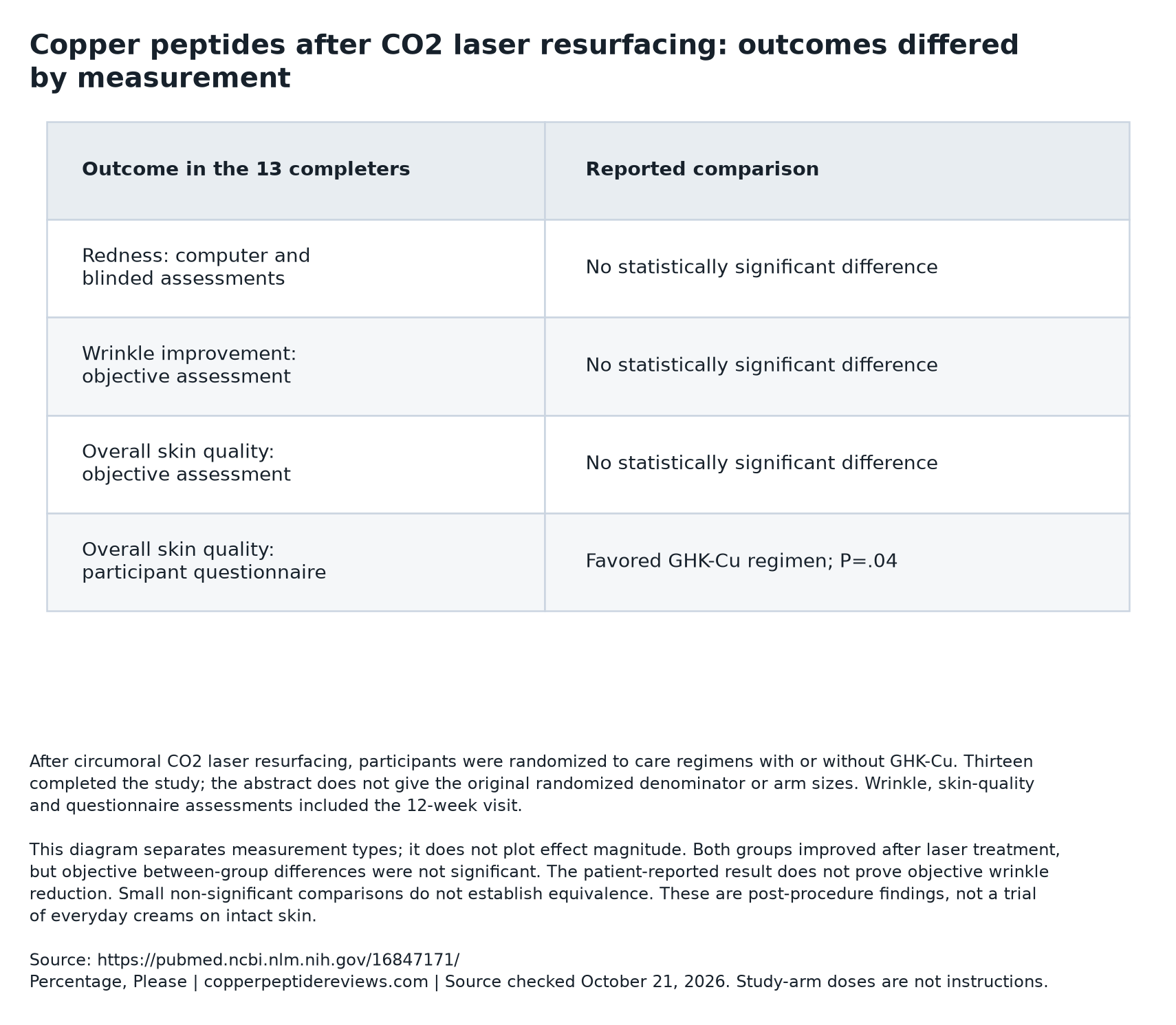
The 2006 study randomized patients after circumoral CO2 laser resurfacing to topical posttreatment regimens with or without GHK-Cu, a copper-bound tripeptide. Redness was assessed by computer analysis and blinded evaluators; wrinkles and overall appearance were assessed at 12 weeks. A validated patient questionnaire was completed before treatment and at 12 weeks. The abstract does not establish a single primary endpoint or describe a hierarchy among these assessments.
The design asks about an adjunct: something added to postprocedure care. Conceptually, both groups receive the major intervention, and the comparison attempts to isolate whatever extra contribution comes from the different regimens. It does not compare copper peptides with doing nothing, nor does it test whether laser resurfacing works. Those are separate questions with different comparators.
Even a randomized adjunct trial does not necessarily isolate a molecule from every other formulation feature. Without a complete formulation comparison, the safest unit of interpretation is the assigned regimen. For readers navigating claims, the guide to copper-peptide study endpoints offers a useful organizing principle: identify the treatment contrast before interpreting the result.
Read the underlying chart data: download CSV or download the source-labeled chart.
Thirteen completers leave the denominator unfinished
A completion count answers how many participants reached the reported finish, not how many entered randomization. The accessible abstract does not provide baseline allocation counts or attrition by arm. Consequently, neither a completion percentage nor a dropout percentage can be calculated from its account. Dividing thirteen into two imagined equal groups would manufacture information rather than recover it.
Illustrative reasoning: a study with thirteen finishers could have started with fourteen people or twenty. Those hypothetical studies would have very different retention patterns despite the same final count. If departures were related to irritation, disappointing results, or unrelated scheduling difficulties, they could also have different implications. These examples are not reconstructions of this trial; they show why the missing starting denominator matters.
Small samples also leave considerable room for chance imbalance. Randomization reduces systematic allocation bias, but it does not guarantee that every relevant characteristic is closely balanced in a particular small experiment. Baseline severity, recovery variability, and questionnaire scores could matter statistically. Without their distributions, readers cannot determine how much precision or adjustment the comparison required.
Improvement over time is not the added treatment effect
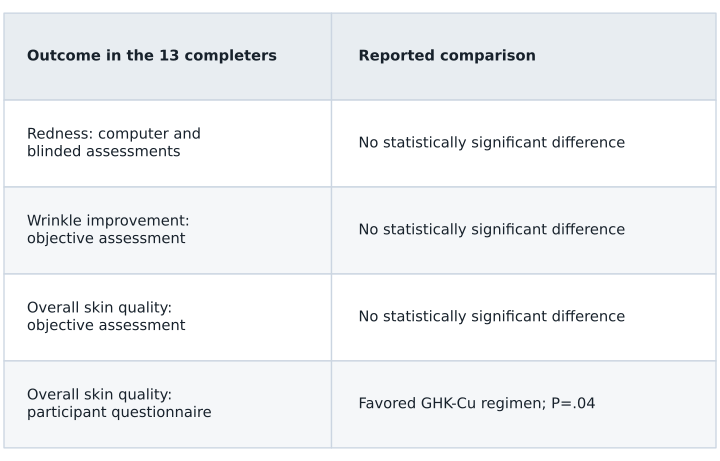
The laser report describes improvement in both groups without a significant between-group advantage for objective wrinkles, overall quality, or redness resolution. This separates two statistical questions: did participants change after the procedure, and did their changes differ according to the added regimen? A favorable answer to the first does not supply a favorable answer to the second.
Illustrative reasoning: suppose a hypothetical appearance scale improves by twelve points in one group and eleven in another. The ingredient-relevant contrast is approximately one point, not twelve. A large before-and-after change can coexist with a small incremental difference. Conversely, modest improvement in both groups could still conceal a meaningful contrast if the measurements were sufficiently precise.
The table distinguishes comparison types rather than reconstructing unavailable scores. This is also why firmness, hydration, and wrinkle claims need different evidence: a favorable measurement cannot silently substitute for another outcome. The interpretation depends on what was measured, against what comparator, and at what time.
Three questions that should not be collapsed into one claim
| Question | Relevant comparison | What it would establish |
|---|---|---|
| Did skin change after resurfacing? | Follow-up versus baseline | Change during the full treatment-and-recovery period |
| Did the added regimen improve measured recovery? | GHK-Cu regimen versus non-GHK-Cu regimen | An incremental objective advantage, if supported |
| Did patients report a better experience? | Questionnaire results between regimens | A patient-reported difference, not automatically an objective one |
A P value does not tell readers how much better
The positive questionnaire finding deserves attention, but statistical significance is not a measurement unit. A P value describes compatibility with a statistical null model under the analysis assumptions. It does not report the size of a score difference, the percentage of patients who noticed a benefit, or the probability that the treatment works.
An effect estimate would tell readers the observed difference in meaningful units. A confidence interval would show how uncertain that estimate remains under the chosen statistical method. Without those quantities, a small, precisely measured questionnaire difference cannot be distinguished from a larger but unstable one simply by inspecting the reported significance result.
Several outcomes also create an interpretive question about multiplicity: were comparisons prioritized in advance, and were adjustments planned? The abstract does not settle that question. This does not invalidate the positive result. It means its evidential weight should depend on the analysis plan and independent confirmation, rather than treating the threshold crossing as a complete clinical conclusion.
Patient reports and blinded ratings measure different things
A patient-reported outcome is not inherently inferior to an image measurement. Comfort, perceived appearance, and satisfaction can matter directly to people undergoing a procedure. But a questionnaire result supports the construct its questions measure. It cannot establish a specific biological change unless that relationship has been demonstrated separately.
Different assessment methods can disagree without either being fraudulent or useless. A photograph samples visible features under particular conditions; a questionnaire samples a person's judgment across an experience. As interpretation, that difference in measurement could contribute to divergent results, but the accessible evidence does not establish why the laser findings differed. Expectations, treatment experience, and measurement sensitivity remain possibilities, not findings.
Blinded evaluators help limit knowledge-driven scoring bias, but evaluator blinding does not establish participant blinding. Nor does describing a questionnaire as validated disclose its score distribution, responsiveness, or meaningful-change threshold in this specific comparison. The unresolved question is therefore not whether patient satisfaction counts; it is how large, reproducible, and specifically attributable the reported advantage was.
The ulcer trial supplies context, not a facial result
The 1994 multicenter ulcer study was randomized, evaluator-blinded, and vehicle-controlled. Participants received standardized wound care. Its immediate component compared topical 2% GHK-Cu gel with vehicle for up to eight weeks, followed by six weeks of observation. A delayed component used four weeks of vehicle before eight further weeks involving vehicle or 2% or 4% gel. These concentrations identify historical study arms, not treatment instructions.
This is a different biological and clinical setting from postlaser facial care. A neuropathic ulcer is an open wound managed within a structured care program; a retail facial product has a different intended use, formulation, and application environment. Sharing an ingredient name does not make the treatments interchangeable. The companion analysis of the diabetic-ulcer study examines that trial's wound-specific findings in greater depth.
The immediate and delayed comparisons should also remain distinct. Changing when treatment begins changes the clinical question, not merely the calendar. As methodological interpretation, an early postprocedure effect could differ from an effect after a lead-in because wound conditions evolve. A mechanistic explanation would require measurements of those conditions rather than inference from outcome differences alone.
Area closure is not the percentage of patients healed
In the immediate-treatment plantar-ulcer comparison, median area closure was 98.5% with active gel versus 60.8% with vehicle, with P < .05. These are summaries of wound-area change. Subtracting them gives 37.7 percentage points between medians—not a 37.7-point increase in the proportion of people healed, and not an individual patient's expected benefit.
Illustrative reasoning: reducing a hypothetical wound from 200 square millimeters to 20 closes 90% of its starting area. That wound remains open. Complete closure, near-complete closure, and percentage area reduction are related but distinct outcomes. A median further describes the middle of a distribution, not the average trajectory or the fraction reaching a threshold.
Likewise, speed needs its own units. The ulcer abstract reports approximately threefold faster closure, while the full-text narrative identifies a normalized linear edge-advance measure. That does not mean three times as many people healed. The table keeps the outcome families separate without reproducing uncertain categorical counts from the transcription.
How wound-study measurements change the meaning of a percentage
| Measurement | What the denominator describes | Invalid substitution |
|---|---|---|
| Percentage area closure | Each wound's starting area | Percentage of participants completely healed |
| Proportion meeting a closure threshold | Participants or wounds in a defined analysis group | Median area reduction |
| Normalized linear closure rate | Time, with adjustment for wound geometry | Number of additional patients healed |
Last-visit endpoints complicate the calendar
The ulcer study's end-of-study outcome used the last visit, whether departure followed closure, an adverse event, or another reason. Longitudinal graphs carried the last value forward. Delayed treatment did not show a significant advantage over vehicle. These details prevent the immediate-component estimate from being relabeled a uniform fourteen-week result or generalized to every treatment schedule.
Carrying an observation forward fills later time points with an earlier measurement. Methodologically, this preserves a dataset's size but does not create new observations. It can be particularly consequential when successful healing and clinical deterioration both prompt departure: the reasons for missing later measurements are related to the outcome itself.
A more informative modern report would display participant flow, reasons for withdrawal by group, and sensitivity analyses under different assumptions about missing outcomes. Such analyses could ask whether conclusions persist if unresolved wounds subsequently improve or worsen. This is not a claim that the original conclusion would reverse; it identifies what readers need to assess its stability.
Cellular remodeling does not establish skin delivery
One fibroblast-culture abstract reports increased collagen synthesis, beginning between 10^-12 and 10^-11 molar and peaking at 10^-9 molar, independently of cell-number change. Another reports increased MMP-2 expression and TIMP-1 and TIMP-2 secretion. Copper ions reproduced the MMP-2 effect, whereas the peptide alone did not. These observations concern cells exposed under laboratory conditions.
MMPs are enzymes involved in breaking down extracellular material; TIMPs inhibit such enzymes. Seeing both kinds of activity emphasizes that remodeling is a regulated balance, not simply a command to accumulate collagen. Neither marker by itself supplies a wrinkle measurement, a tissue-strength outcome, or evidence that more activity is necessarily better.
Translating a culture concentration into a cream percentage would skip several unknowns: chemical form, stability, release from the vehicle, penetration, and exposure at the relevant cells. The guide to peptide grade and purity claims addresses a related distinction: documenting material identity is different from documenting biological delivery. A plausible cellular mechanism remains a reason to test a formulation, not a substitute for testing it.
Safety and commercial records need their own audit
The laser abstract supplies neither adverse-event counts nor concentration or funding details. In the ulcer report, infection incidence was 7% versus 34% in the immediate-treatment plantar comparison; overall adverse-event rates did not differ significantly. Exact event counts are unavailable here. Corporate affiliations and the identified study product document ProCyte involvement, but not a formal funding statement.
A lower infection percentage in that restricted comparison is a real safety-related finding, not evidence of general infection prevention. Conversely, a nonsignificant overall adverse-event comparison does not establish equal safety. Event definitions, observation time, withdrawals, and statistical precision matter. The available reports cannot support a blanket assurance about all copper products or all routes of exposure.
Editorial interpretation: documentary purchasing questions should remain separate from clinical ones. The AgelessRx review and Defy Medical review can be used to check stated product and transaction terms, not to infer trial-equivalent treatment or outcomes. The monthly-price comparison guide likewise concerns how charges are described. No historical clinical result automatically transfers to a provider, compounded preparation, injection, oral route, or different finished formula.
Questions about the evidence
Does a nonsignificant objective result prove copper peptides have no effect?
No. A conventional superiority test asks whether the data provide sufficient evidence of a difference under its assumptions. Failure to meet that standard is not an equivalence finding. Demonstrating equivalence would require a suitable design, a justified margin, and sufficiently precise estimates. The absence of a reported confidence interval makes the range of compatible effects especially difficult to judge here.
Could the patient-reported result still matter?
Yes. A patient-reported benefit can be worthwhile on its own terms. The unresolved issue is magnitude: statistical significance alone does not identify a noticeable or important improvement. Access to the questionnaire scoring, group distributions, missing-data handling, and meaningful-change threshold would help distinguish a useful experience benefit from a numerically detectable but minor difference.
Why not combine the laser and ulcer results into one effectiveness percentage?
A pooled percentage would require compatible outcomes and denominators. Appearance ratings and wound-area closure do not measure the same quantity. The populations and background treatments also differ. Combining them would produce apparent precision without a coherent clinical meaning. They are better used to identify distinct research questions about postprocedure care, wound healing, and formulation-specific performance.
Does a higher labeled concentration imply a better result?
Not from these studies. Concentration is one feature of an exposure, not a complete measure of delivery. Vehicle, chemical stability, application conditions, and tissue access can change what reaches a biological target. Comparisons across different products are therefore not a dose-response experiment, even when their percentage labels look easy to rank.
What evidence would make a future postlaser trial more useful?
A larger study could specify a primary outcome, report all randomized participants and withdrawals, describe the comparator formulations, and provide effect estimates with confidence intervals. Prespecified patient-reported and objective outcomes would allow both to be interpreted without forcing agreement. Detailed adverse-event reporting and independent replication would improve the assessment of benefit, uncertainty, and tolerability.
What this evidence supports
The laser evidence supports neither a broad objective recovery claim nor a declaration that copper peptides are ineffective. Its strongest interpretation is endpoint-specific: a patient-reported signal deserves further study, while the objective comparisons did not establish an added advantage. The ulcer and cellular evidence make biological investigation reasonable but do not fill the missing facial effect size. For a numerical claim to travel beyond its original study, its outcome, denominator, comparator, timing, and formulation must travel with it.
Research access and limitations
This analysis uses indexed primary abstracts for the laser and cell studies and the ulcer abstract alongside an author-posted primary full-text OCR transcription. It does not represent review of every protocol, supplement, or formatted full article. Scrambled ulcer-table arm counts and categorical rates are excluded because the original layouts were not verified. Trial reports are historical research records, not current prescribing information.
Sources behind this reading
- 2006 CO2 Laser Copper-Tripeptide Study: Accessible Abstract ↗Primary study abstract only · Checked October 21, 2026
- Mulder et al., 1994: GHK-Cu in diabetic neuropathic ulcers (author-posted full text) ↗Author-posted primary full-text OCR; original table and figure layout not verified · Checked October 21, 2026
- Enhanced healing of ulcers in patients with diabetes by topical treatment with glycyl-l-histidyl-l-lysine copper. ↗Indexed primary study abstract · Checked October 21, 2026
- Stimulation of collagen synthesis in fibroblast cultures by the tripeptide-copper complex glycyl-L-histidyl-L-lysine-Cu2+. ↗Indexed primary laboratory-study abstract · Checked October 21, 2026
- The tripeptide-copper complex glycyl-L-histidyl-L-lysine-Cu2+ stimulates matrix metalloproteinase-2 expression by fibroblast cultures. ↗Indexed primary laboratory-study abstract · Checked October 21, 2026