Scientific article · Sources checked October 21, 2026
The 98.5% Copper-Peptide Ulcer Result Measures Area, Not Patients Healed
A percentage audit of the 1994 diabetic-ulcer trial separates wound shrinkage, closure speed, infection findings, and the evidence needed for cosmetic claims.
Editorial source review, with no clinician sign-off or firsthand treatment experience claimed.
A wound that loses almost all its open area has improved substantially. But that observation is not the same as almost every patient healing. This distinction sits at the center of a frequently cited copper-peptide study: its prominent percentage describes a wound-area measurement, not a success rate among people. Reading it correctly requires identifying what was measured, which comparison produced it, and when the measurement was taken.
The evidence deserves neither dismissal as merely laboratory research nor promotion as proof for unrelated products. There was a controlled human ulcer trial. Its results support a narrower proposition than a general copper-peptide benefit. The useful exercise is to keep each number attached to its denominator and endpoint, then distinguish the clinical observations from the biological explanations and commercial inferences built around them.
In this article
Study facts at a glance
Publication date: The ulcer paper was published in 1994; its later PubMed indexing does not make it a 2006 trial. Source 1
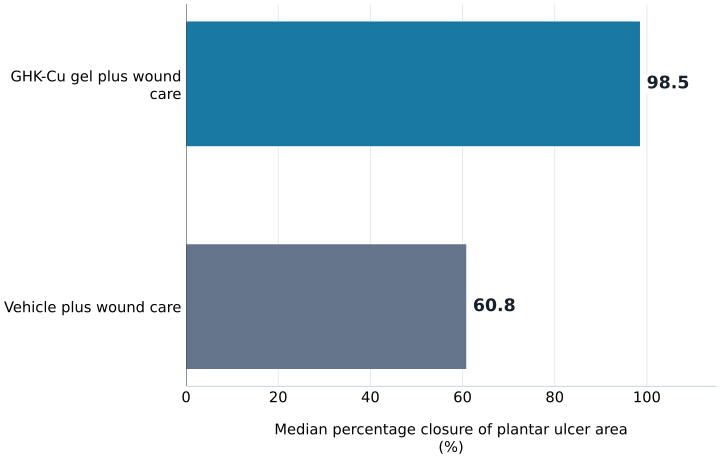
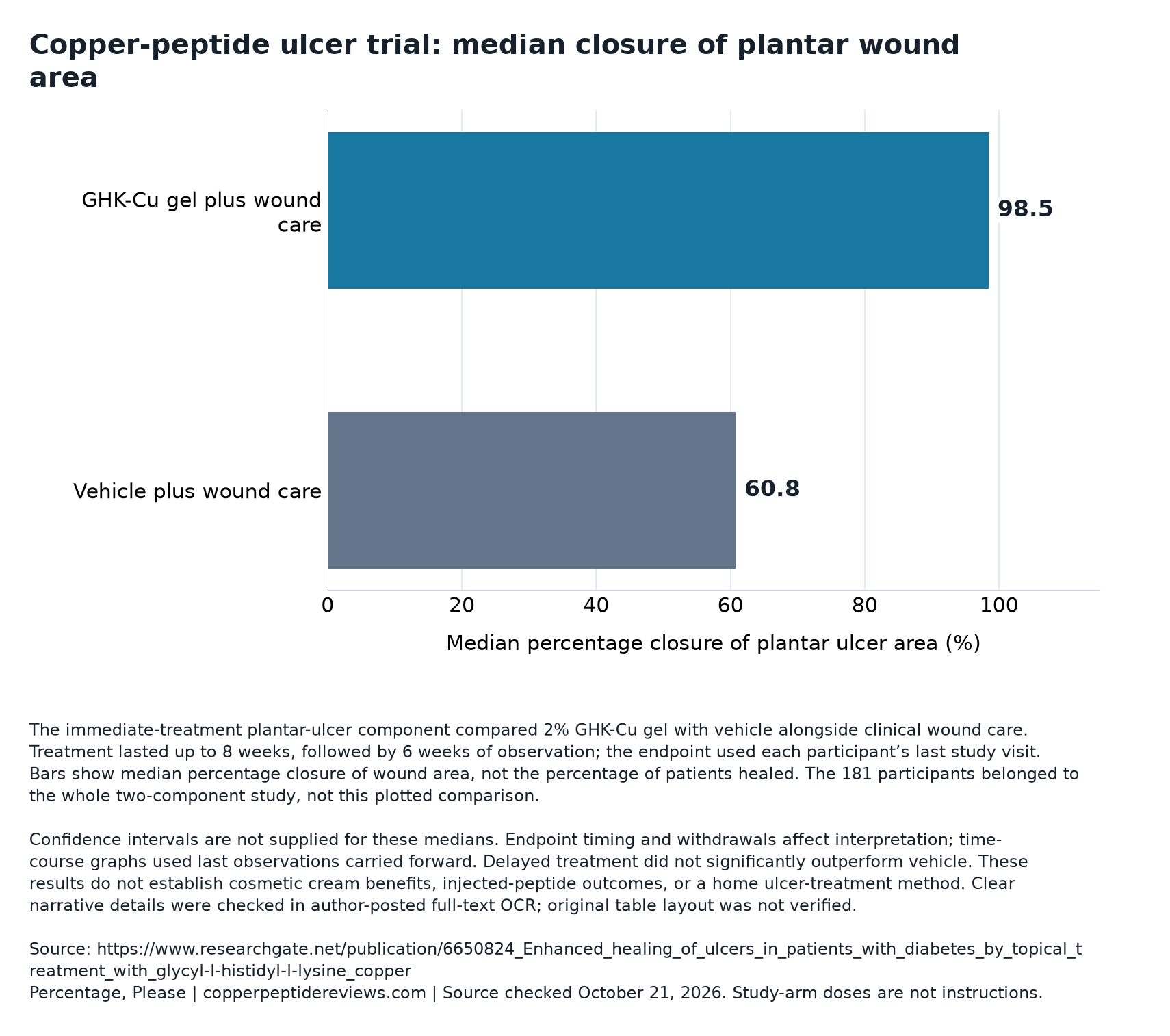
Headline endpoint: Median wound-area closure was 98.5% with active gel versus 60.8% with vehicle in the immediate-treatment plantar comparison. Source 2 Source 1
Whole study versus subgroup: The study enrolled 181 patients, not 181 patients in the headline comparison. Source 1
Infection finding: Reported infection incidence of 7% versus 34% concerned plantar ulcers treated immediately after debridement, not the entire trial. Source 2
Separate facial evidence: A small postlaser trial distinguished objective assessments from a positive patient-reported result; neither endpoint is interchangeable with ulcer closure. Source 5
What the ulcer experiment actually compared
The randomized, evaluator-blinded, multicenter trial compared topical GHK-Cu gel with vehicle alongside standardized debridement, pressure-relieving footwear, and education. Participants had diabetic neuropathic ulcers; eligibility excluded conditions including bone infection and gangrene. Immediate treatment used 2% gel for up to eight weeks followed by six weeks of observation. A delayed component used four weeks of vehicle followed by eight weeks of vehicle, 2%, or 4% gel. These concentrations identify historical study arms, not treatment instructions.
The comparator matters as much as the ingredient. A vehicle is the formulation without the tested active component; it is not necessarily equivalent to leaving a wound untreated. Shared care creates a demanding and clinically meaningful question: does adding the active formulation improve outcomes beyond the same background program? It also limits attribution. Improvement within an active group alone cannot establish an ingredient effect when the comparison group receives other interventions capable of changing the outcome.
Read the underlying chart data: download CSV or download the source-labeled chart.
The denominator inside an area percentage
Percentage area closure compares the reduction in an individual wound’s open area with its starting area. As an explicitly illustrative calculation, a wound shrinking from 200 to 20 square millimeters has closed 90% of its initial area: the reduction is 180, divided by the original 200. That calculation contains no count of patients. To obtain a patient healing proportion, investigators must instead define a healing threshold, count those meeting it, and divide by an appropriate participant denominator.
The reported median therefore answers a different question from a healing proportion. A median locates the middle of ordered observations; it does not say that the same percentage of participants achieved complete closure. The headline between-group separation is 37.7 percentage points, calculated by subtraction. It is not a 37.7% increase in the number healed. The guide to copper-peptide study endpoints offers a broader framework for keeping measurements with their proper denominators.
Different wound measurements answer different questions
| Measurement | Denominator or unit | What it does not establish |
|---|---|---|
| Percentage area closure | Reduction relative to the wound’s initial area | The percentage of patients healed |
| Proportion reaching a closure threshold | Qualifying patients divided by the relevant patient group | The amount of shrinkage in every wound |
| Closure rate | Change per unit of time under the specified method | A matching multiplication of patient success |
| Infection incidence | Patients or ulcers with infection in the specified comparison | Infection prevention across all settings |
Why negative closure is mathematically possible
For study-defined larger plantar ulcers around the 100-square-millimeter threshold, the abstract reports median closure of 89.2% versus −10.3%, with P < .01. The body OCR describes 10.4% enlargement instead, leaving a 0.1-point discrepancy unresolved. Negative closure means enlargement, not a negative proportion of patients healing. For illustration, growth from 200 to 220 square millimeters produces −10% closure because the area reduction is minus 20.
This scale is asymmetric. A wound can close no more than its entire starting area, but enlargement has no corresponding mathematical lower bound. One substantially worsening wound can consequently pull a group mean downward more strongly than one fully closing wound can pull it upward. A median is less sensitive to that extreme observation, but it also conceals how widely outcomes vary. Neither summary should be mistaken for a description of every participant’s experience.
The last visit is not a shared finish line
Weekly tracings supplied the area measurements. The endpoint used each participant’s last visit, including departures for closure, adverse events, or other reasons; longitudinal graphs carried the last value forward. Infection unresponsive after a week of treatment triggered withdrawal. Thus, the headline result is not uniformly a 14-week measurement. All participants were included analytically, including four with only a prestudy assessment.
Interpretation: carrying a value forward preserves a record in a graph, not knowledge of what happened afterward. If a wound is improving when follow-up ends, the carried value does not capture further improvement. If it is deteriorating, it does not capture further deterioration. Those possibilities can operate in opposite directions, so the method is not automatically favorable or unfavorable to treatment. An analysis is more informative when it shows whether conclusions change under plausible alternative assumptions about missing follow-up.
A faster rate is not a multiplied healing probability
The abstract describes a roughly threefold closure-rate advantage. Rate and probability are different mathematical objects. A rate describes how quickly a measured process proceeds; a probability describes how often a defined outcome occurs. Even when both favor treatment, one cannot substitute for the other. Nor does a rate ratio by itself establish that the time to complete healing was divided by the same factor.
The full report identifies the Gilman measure as normalized linear wound-edge advance, expressed in millimeters per day. The unit describes a calculated distance over time. It differs from square millimeters of surface area lost each day, and neither unit counts the people whose wounds have closed. Naming that unit makes the speed claim more informative than repeating a ratio alone.
Consider an illustrative process moving twice as quickly early on but slowing near completion. Its early rate ratio would not guarantee completion in half the time. Wounds also begin with different geometry, so comparing raw area loss can answer a different question from comparing movement of their boundaries. The practical audit is to ask for the rate’s units, its observation interval, and its calculation method before translating a speed claim into a patient-level promise.
As an illustrative geometric comparison, imagine two circular wounds of different starting sizes. If each loses the same fraction of its area, the larger wound loses more square millimeters. Their equal percentage reductions therefore do not imply equal absolute area changes. Conversely, an equal inward movement of their edges need not remove the same fraction of each starting area. This is why the chosen normalization belongs beside the reported rate: it determines which features of differently sized wounds the analysis attempts to compare.
Treatment timing changes the scope of the finding
Delayed treatment did not show a statistically significant advantage over vehicle. That is a between-group result, not evidence that delayed-treatment wounds remained unchanged. The immediate and delayed components should not be pooled into a general claim that every tested use worked. Timing belongs in the description of the intervention rather than appearing as a minor footnote after a favorable percentage.
The unresolved scientific question is why the comparisons differed. An observed timing pattern can motivate hypotheses about the wound environment or access to tissue, but it does not establish those mechanisms. A stronger investigation would distinguish timing from the other features that evolve during a lead-in period. Interpretation should therefore remain at the level of the tested comparison: evidence attached to one treatment sequence is not automatically evidence for another sequence, even when the ingredient name matches.
Reading the infection result without declaring general safety
The reported infection comparison was statistically significant at P < .05. Subtracting the group percentages gives a 27-percentage-point separation. That is an absolute difference between reported group results, not a 27% relative reduction. Expressing a comparison relatively would require dividing the difference by the comparator percentage, but changing presentation would not expand the population to which the finding applies.
Overall adverse-event rates did not differ significantly. This does not establish equal safety: failure to detect a difference is not an equivalence test. Infection, total adverse events, local tolerability, and longer-term outcomes are distinct safety questions. A favorable result for one does not resolve the others. In particular, without verified event counts and adequate uncertainty estimates, a precise-looking percentage can convey more confidence than the available safety reporting warrants.
Statistical significance leaves important quantities unanswered
The headline area comparison reached P < .05, but confidence intervals were not provided. A P-value addresses compatibility with a statistical null under the analysis assumptions; it does not describe the range of treatment effects that remain plausible. A confidence interval would better communicate precision. Subtracting two medians supplies a descriptive separation, not a confidence interval and not necessarily the typical individual treatment benefit.
Several endpoints and subgroup comparisons also create a need to understand the analysis plan. Agreement among measurements can strengthen a coherent interpretation, but related measurements from the same wounds are not independent replications. The next evidentiary step is not simply another favorable percentage: it is a clearly specified endpoint, transparent participant flow, adequately precise estimates, and replication. For product-facing reading, the guide to grade and purity claims separates documentary ingredient claims from these clinical requirements.
Cells, ulcers, and laser-treated skin answer different questions
In fibroblast cultures, one study reported increased collagen synthesis without a change in cell number. Another found increases in MMP-2 and its messenger RNA, accompanied by increased secretion of TIMP-1 and TIMP-2. These findings concern tissue production and remodeling signals, not measured facial rejuvenation. In the randomized postlaser study, 13 patients completed follow-up: objective between-group advantages were not significant, while a patient-reported assessment favored GHK-Cu at P = .04.
These studies are not interchangeable votes for or against a universal effect. They differ in biological setting, intervention context, and measurement. A laboratory signal may justify clinical investigation without predicting its magnitude or direction. Likewise, subjective satisfaction and instrument-based appearance measurements can diverge without either being meaningless. The separate analysis of the laser-resurfacing trial examines that distinction, while the firmness, hydration, and wrinkle evidence guide explains why cosmetic endpoints need their own definitions.
What each evidence setting contributes
| Evidence setting | Observed endpoint | Unanswered transfer question |
|---|---|---|
| Diabetic-ulcer trial | Wound closure and related clinical measurements | Would a different formulation or tissue setting reproduce the result? |
| Postlaser clinical trial | Redness, appearance assessments, and patient reports | Would findings apply to routine use on intact skin? |
| Collagen fibroblast experiment | Collagen synthesis in culture | Would exposure produce a meaningful clinical appearance change? |
| MMP-2 fibroblast experiment | Remodeling enzymes and inhibitors in culture | How would the combined signals affect a patient outcome? |
What a product claim would need to bridge
Interpretation: transferring an ulcer result to a facial product requires more than a shared ingredient name. The evidentiary bridge includes formulation, delivery, tissue condition, exposure, comparator, and an outcome relevant to the advertised benefit. Neither topical wound research nor cell-culture activity establishes results from systemic injections. A percentage on a label is a formulation description, not an outcome probability. The public-record product comparison guide provides a way to organize those distinctions.
Commercial and documentary questions remain separate from biological ones. ProCyte affiliations and development-team involvement identify commercial participation, without establishing a formal funding statement. Readers checking provider-facing documentation can consult the AgelessRx review or Defy Medical review for the terms requiring verification. Those links do not imply availability of the trial product, ulcer care, or comparable outcomes. Interpretation: contractual clarity can improve a purchasing decision, but it cannot supply a missing clinical comparison.
Questions about the evidence
Does near-complete area closure mean a wound is completely healed?
Not necessarily. Area reduction and complete healing are different endpoint definitions. A small residual opening can coexist with a very high percentage reduction. To interpret a healing claim, look for the exact threshold, how closure was assessed, and whether persistence of closure was evaluated. A rounded percentage should not silently replace those requirements.
Why not calculate a number needed to treat from the headline result?
A number needed to treat requires an absolute difference in the probability of a defined outcome over a specified period. A difference between median area-closure percentages is not such a probability difference. Treating it as one would mix a continuous wound measurement with a patient-level event calculation and produce a misleading answer.
Does a nonsignificant comparison mean nothing happened?
No. It means the statistical comparison did not meet the specified significance criterion. Both groups might improve, both might worsen, or their changes might differ too imprecisely to distinguish convincingly. Within-group change and between-group advantage are separate questions; a conclusion about one should not be rewritten as a conclusion about the other.
Does greater collagen production in cells establish a cosmetic benefit?
No. Cell experiments can identify biological activity, but a cosmetic benefit requires evidence connecting a usable formulation to a meaningful outcome in people. The remodeling study also illustrates why a single production signal is incomplete: tissue behavior involves interacting processes, not simply accumulating more of one material. Mechanistic plausibility is a starting point for testing.
What would make a future ulcer study more informative?
A useful study would clearly prespecify its main endpoint and treatment sequence, report participant flow and verified event counts, quantify uncertainty, and examine how missing observations affect conclusions. Confirmed closure and subsequent follow-up would answer different questions from area shrinkage alone. Independent replication would help distinguish a reproducible clinical effect from a finding dependent on one study’s design.
What this evidence supports
The ulcer evidence supports taking the tested topical intervention seriously within its specific clinical comparison. It does not support converting a median wound-area result into a patient healing rate or exporting that result to facial creams and injections. The most informative reading preserves the favorable finding while narrowing the claim: endpoint, treatment sequence, comparator, and population remain attached. For consumers, that discipline is more useful than either a sweeping efficacy promise or a blanket assertion that copper peptides have no human evidence.
Research access and limitations
This analysis uses the indexed primary ulcer abstract and an author-posted full-text OCR, whose original table and figure layouts were not verified. Ambiguous arm counts and categorical healing proportions are therefore not reproduced. The laser and laboratory analyses use indexed primary-report abstracts, not examined full protocols or supplements. Trial reports do not establish current prescribing information or instructions for home wound care.
Sources behind this reading
- Mulder et al., 1994: GHK-Cu in diabetic neuropathic ulcers (author-posted full text) ↗Author-posted primary full-text OCR; original table and figure layout not verified · Checked October 21, 2026
- Enhanced healing of ulcers in patients with diabetes by topical treatment with glycyl-l-histidyl-l-lysine copper. ↗Indexed primary study abstract · Checked October 21, 2026
- Stimulation of collagen synthesis in fibroblast cultures by the tripeptide-copper complex glycyl-L-histidyl-L-lysine-Cu2+. ↗Indexed primary laboratory-study abstract · Checked October 21, 2026
- The tripeptide-copper complex glycyl-L-histidyl-L-lysine-Cu2+ stimulates matrix metalloproteinase-2 expression by fibroblast cultures. ↗Indexed primary laboratory-study abstract · Checked October 21, 2026
- 2006 CO2 Laser Copper-Tripeptide Study: Accessible Abstract ↗Primary study abstract only · Checked October 21, 2026